

The Burj Khalifa observation decks (floors 124 and 125, included in the standard At the Top ticket) feature six main exhibits and interactive elements: the Sky Map interactive touchscreen system for landmark identification, high-powered telescopes on the indoor gallery, the glass floor on level 125 with animated crack effects, LED wall displays showcasing Dubai’s development, the ‘Dubai – A Falcon’s Eye View’ VR/AR experience on floor 125, and construction and architectural history displays throughout. All exhibits are included in the standard At the Top ticket — no additional charge.
The Burj Khalifa observation decks are more than just a platform to look at a view — the exhibits and interactive elements inside add context, entertainment, and perspective to the visit. This guide covers every exhibit on floors 124 and 125, what it does, and how to get the most from each one. For the floor-by-floor breakdown of the entire tower, see our floor map guide.
Top Tickets
# Level 124 & 125 Ticket – At the Top Burj Khalifa
# Level 124, 125 & 148 Ticket – At the Top SKY (Premium)
Table of Contents
Sky Map Interactive Touchscreens (Floors 124 & 125)
High-powered telescopes are positioned at key positions around the indoor gallery on floors 124 and 125, and at the floor 148 SKY deck. The telescopes provide magnified views of specific landmarks visible from the observation deck — allowing close-up inspection of buildings, the Palm Jumeirah’s fronds, ships on the Gulf, and desert detail not visible to the naked eye. Digital interfaces and touchscreen controls allow visitors to adjust magnification and direction.
The Sky Map is effectively an in-built audio tour and educational exhibit rolled into a single interface. For visitors who want to understand what they’re looking at — which tower is which, how far away the desert is, where the Palm Jumeirah lies — the Sky Map is the most informative element on the decks. It’s available in multiple languages and is designed for all ages.
High-Powered Telescopes (Floors 124 & 125)

High-powered telescopes are positioned at key positions around the indoor gallery on floors 124 and 125, and at the floor 148 SKY deck. The telescopes provide magnified views of specific landmarks visible from the observation deck — allowing close-up inspection of buildings, the Palm Jumeirah’s fronds, ships on the Gulf, and desert detail not visible to the naked eye. Digital interfaces and touchscreen controls allow visitors to adjust magnification and direction.
The telescopes are particularly valuable on clear winter days (November to March) when long-distance visibility is at its best. At maximum magnification, it’s possible to resolve the individual structures of the Palm Jumeirah, identify specific towers on the Dubai Marina skyline 25 km away, and see the Hajar Mountains on the UAE/Oman border. For photography tips using the telescopes and the outdoor terrace, see our photography guide.
The Glass Floor (Floor 125)
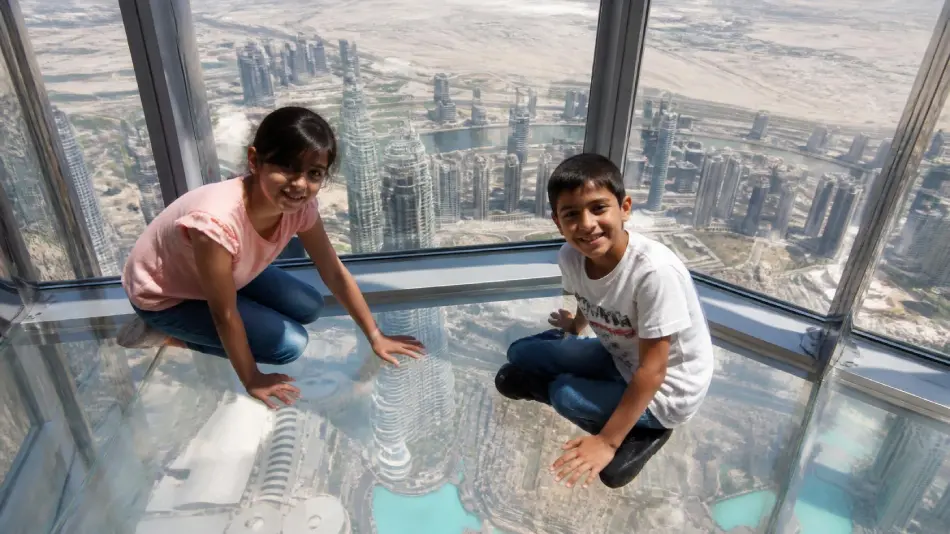
The glass floor on level 125 is the exhibit most consistently mentioned by visitors as a highlight of the Burj Khalifa experience. Transparent reinforced glass panels in the floor provide a direct view straight down 455 metres to the streets and buildings below. As visitors step onto the glass, animated ‘crack’ effects appear beneath their feet — the visual illusion of the floor breaking under their weight. The effect is disorienting in a deliberately thrilling way and creates a memorable photograph.
The glass itself is reinforced high-strength laminated glass engineered to support the weight of the visitor numbers passing over it and the significant wind loads at this height. The floor has undergone safety testing well in excess of any load it would realistically encounter. Despite how alarming it looks, it is structurally one of the most over-engineered elements in the building. For visitors with a fear of heights, it helps to observe other visitors on the glass first — most find that once they step on, the experience is more thrilling than frightening.
Dubai – A Falcon’s Eye View (Floor 125)

‘Dubai – A Falcon’s Eye View’ is an immersive VR/AR experience on floor 125 that simulates a flight over Dubai from the perspective of a falcon. Using headsets and spatial audio, it provides a bird’s-eye tour of Dubai’s landmarks, coastline, and desert from above — a perspective impossible to experience from the observation deck itself. The falcon is a significant cultural symbol in the UAE, representing the country’s Bedouin heritage and its national identity.
The Falcon’s Eye experience is available throughout observation deck opening hours on floor 125 and is included in the standard At the Top ticket. It’s particularly popular with children and with visitors who want a different perspective beyond the static view from the glass panels. The experience takes approximately 5–8 minutes.
LED Wall Displays

LED wall displays in the elevator lobby and transition areas between floors 124 and 125 showcase Dubai’s transformation over time — from a coastal fishing settlement to one of the world’s most architecturally ambitious cities. The displays use time-lapse photography, animation, and documentary content to put the views from the observation deck in historical and developmental context.
The LED displays in the elevator are particularly striking — the ascent to floor 124 takes approximately 60 seconds, and the walls of the elevator cabin show a time-compressed animation of Dubai’s skyline growing from the 1970s to the present day. It’s a subtle but effective way to prime visitors for the view they’re about to experience.
Construction and Architectural History Exhibits (Floors 124 & 125)
Display panels and interactive exhibits throughout the indoor gallery on floors 124 and 125 cover the construction of the Burj Khalifa in detail — the engineering challenges of building the world’s tallest structure, the Hymenocallis flower design inspiration, the workforce of 12,000 people at peak construction, and the records broken during the build. For visitors interested in architecture and engineering, this content provides excellent context. For the full facts and figures on the tower’s construction, see our Burj Khalifa facts guide.
What to Expect on the At the Top SKY Deck (Floor 148)
The floor 148 SKY experience includes telescopes similar to those on floors 124 and 125, the outdoor observation area at 555 metres (the world’s highest publicly accessible outdoor deck), and a personal guest ambassador who provides guided commentary on the view and landmarks. The SKY experience is more curated and less exhibit-heavy than floors 124 and 125 — the focus is on the hosted premium experience and the elevated view rather than interactive displays. For full details, see our At the Top SKY tickets guide.
Tips for Getting the Most from the Exhibits
- Allow time: Most visitors underestimate how long the exhibits take — budget 90 minutes minimum, 2 hours if you want to explore thoroughly
- Glass floor: Visit during non-peak hours for the best experience — at sunset, the glass floor area can be crowded. Morning visits give more space
- Telescopes: Best used on clear winter days (November–March) when visibility is at its longest. In summer, haze limits long-distance detail
- Sky Map: Use it before looking out at the view to orient yourself — knowing where north is and which buildings to look for makes the panorama significantly more meaningful
- Falcon’s Eye: Can have a short queue at peak times — visit this first thing on arrival or just before leaving when the queue tends to be shorter
Frequently Asked Questions
Are the exhibits included in the standard Burj Khalifa ticket?
Yes. All exhibits on floors 124 and 125 — the Sky Map, telescopes, glass floor, Falcon’s Eye VR experience, LED displays, and construction exhibits — are included in the standard At the Top ticket. No additional charge applies.
What is the glass floor at Burj Khalifa?
The glass floor is on level 125. Transparent reinforced glass panels allow a direct view 455 metres straight down to the streets below. Animated ‘crack’ effects appear underfoot. It is the exhibit most frequently cited by visitors as a highlight of the experience.
What is the Sky Map at Burj Khalifa?
The Sky Map is an interactive touchscreen system on the indoor gallery of floors 124 and 125. It identifies landmarks visible through the glass, provides historical and architectural information, and covers the Burj Khalifa’s own construction. Available in multiple languages.
Is the Falcon’s Eye experience free?
Yes. The ‘Dubai – A Falcon’s Eye View’ VR/AR experience on floor 125 is included in the standard At the Top ticket at no additional charge.
How long do the exhibits take to see?
Thoroughly exploring all exhibits on floors 124 and 125 takes approximately 60–90 minutes, in addition to time spent on the outdoor terrace and at the telescopes. Budget 2 hours total for a complete visit.
