
From the Burj Khalifa observation decks, you can see: Downtown Dubai directly below (including the Dubai Fountain on Burj Lake); the Dubai Marina skyline approximately 25 km to the west; the Palm Jumeirah approximately 30 km to the west; the Arabian Gulf coastline; the vast desert landscape stretching south and east; and on clear winter days, the Hajar Mountains over 100 km away on the UAE/Oman border. At sunset, the view transitions from a clear daylight panorama to a golden-hour cityscape to the fully illuminated night city. Each transition is distinct.
The views from Burj Khalifa are extraordinary for a specific reason beyond sheer height: Dubai’s unusual geography places the world’s tallest building at the junction of the city, the desert, and the sea. From 452 metres (or 555 metres at the SKY deck), you see three completely different landscapes simultaneously — the dense, glittering urban grid of Downtown Dubai directly below; the open desert spreading to the horizon in the south and east; and the Gulf coastline in the west, with its artificial archipelagos and the blue water stretching to the horizon. This combination is unique. No other city offers this particular view at this height.
Top Tickets
# Level 124 & 125 Ticket – At the Top Burj Khalifa
# Level 124, 125 & 148 Ticket – At the Top SKY (Premium)
Table of Contents
What You Can See: Direction by Direction

Looking Down: Downtown Dubai & Burj Lake
Directly below the observation deck, Burj Lake and the Dubai Fountain are visible — the fountain’s 274-metre length and 30-acre lake look surprisingly compact from 452 metres above. The grid of Downtown Dubai’s towers, the roof of Dubai Mall, and the pedestrian promenades around the lake are all clearly visible. The Burj Khalifa’s own shadow falls across the water and surrounding streets depending on the time of day.
North: Dubai Marina Skyline
Looking north-northwest from the outdoor terrace on floor 124, the cluster of towers forming Dubai Marina is visible approximately 25 km away on a clear day. The distinctive shapes of the Cayan Tower (twisted), the Princess Tower (once the world’s tallest residential building), and the Marina skyline cluster are identifiable. The high-powered telescopes on floor 124 allow close-up views of individual building details at this distance.
West: Palm Jumeirah & The Arabian Gulf
The Palm Jumeirah — Dubai’s iconic palm-shaped artificial archipelago — is visible to the west-southwest, approximately 30 km from the Burj Khalifa. From this height, the full palm frond structure is clearly legible, including the crescent breakwater enclosing the outer ring. Beyond the Palm, the blue expanse of the Arabian Gulf stretches to the horizon. The Burj Al Arab hotel — on a small island approximately 18 km away — is visible as a distinctive sail-shaped silhouette on the waterfront. See our photography guide for the best lens options for these distant shots.
South & East: The Desert
In the southern and eastern directions, Dubai’s urban density drops away rapidly and the desert takes over. The scale of the Arabian Desert — the Rub’ al Khali, or Empty Quarter — becomes comprehensible from this height. The transition from city to desert happens within a few kilometres of the observation deck in these directions. On very clear days, the ridgeline of the Hajar Mountains — which form the UAE/Oman border — is visible to the east at distances exceeding 100 km.
East: Dubai Frame & Older City
The Dubai Frame — the 150-metre picture-frame structure in Zabeel Park — is visible to the north-east, approximately 12 km from the Burj Khalifa. Beyond it, the older residential and commercial districts of Deira and Bur Dubai spread toward the Creek, visible as a glinting silver thread in the urban fabric. The Dubai Frame’s unique shape is clearly identifiable with the naked eye from the observation deck. The high-powered telescopes can resolve the glass sky bridge connecting the two towers. See our nearby attractions guide for how to visit the Frame.
Daytime vs Sunset vs Night Views
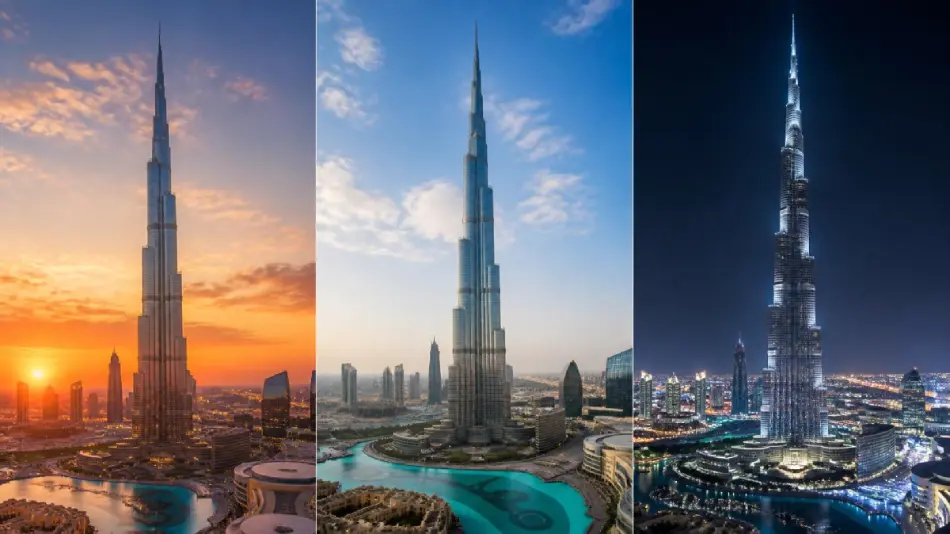
The views from Burj Khalifa change dramatically through the day: daytime offers the sharpest long-distance clarity and the best visibility of the desert and Gulf coastline; sunset brings golden-hour light across the city and the dramatic day-to-night transition — the most photographed view from the deck; night reveals Dubai’s full illuminated extent — a sea of warm light stretching in every direction, with the fountain performing below and the city’s towers lit from within. Each is genuinely distinct.
Daytime Views (Morning to 3 pm)
Daytime offers the longest visibility and the clearest conditions for identifying distant landmarks. Morning (8 am–noon) is particularly good in winter months (November–March) when humidity is low and haze is minimal. The desert is at its most visible — the texture of dunes and gravel plain is discernible. The Gulf has its most vivid blue colouration in morning light. The downside of daytime is the absence of the dramatic lighting effects that make sunset and night visits so memorable.
Sunset Views (3 pm–7 pm)
Sunset is the most sought-after view from Burj Khalifa. The golden-hour light — when the sun drops to approximately 15–20 degrees above the horizon — casts warm amber and orange across the entire Dubai skyline, reflecting off the glass towers and the Gulf. The view transitions through three distinct phases over approximately 90 minutes: bright daylight with long shadows; the golden hour when the light is most dramatic; and the moment the city lights switch on as natural light fades, gradually revealing the full illuminated extent of the urban area. This transition is the classic Burj Khalifa experience. See our sunset tickets guide for booking advice.
Night Views (After 7:30 pm)
After dark, Dubai becomes a different city from the air. The towers of Downtown and Marina, lit from within and by exterior illumination, create the warm golden glow that characterises Dubai’s night panorama. The Burj Khalifa light show — visible on the tower’s facade from 7:45 pm — adds movement and colour to the view when seen from below, though from the observation deck itself you’re inside the show rather than watching it. The Dubai Fountain performs every 30 minutes from 6 pm — visible from the outdoor terrace as a choreographed movement of water and light, 302 metres below. Night visits after 9 pm are significantly calmer than the sunset peak and carry non-prime pricing. See our night tickets guide.
How Do Views Differ Between Floor 124 and Floor 148?
Floor 148 is 103 metres higher than floor 124. The practical difference: on clear days, significantly more of the Gulf coastline is visible, the desert horizon extends further, and the Hajar Mountains are more discernible. On hazy days, the additional height matters less. The view from floor 148 feels perceptibly more elevated — the city below looks slightly smaller, and the sense of being above everything is more pronounced. For photography, floor 148 also benefits from the smaller crowd, giving more time and space to frame shots.
Best Time for the Best Views

- Clearest long-distance visibility: Winter mornings (November–March, 8 am–noon) — low humidity, maximum visibility to the Hajar Mountains and Gulf detail
- Most dramatic lighting: 60–90 minutes before sunset — golden hour across the city, the full day-to-night transition
- Most atmospheric: After 9 pm — full illuminated cityscape, quieter deck, non-prime pricing
- Avoid for long-distance views: Summer daytime (June–September) — heat haze reduces visibility beyond 20–30 km
For a full breakdown of timing, crowd levels, and pricing, see our best time to visit Burj Khalifa guide.
Frequently Asked Questions
Can you see the Palm Jumeirah from Burj Khalifa?
Yes. The Palm Jumeirah is visible to the west-southwest, approximately 30 km from the Burj Khalifa. The full palm frond structure and crescent breakwater are clearly legible from the observation deck, particularly with the high-powered telescopes.
How far can you see from Burj Khalifa?
In clear winter conditions (November–March), visibility from the observation deck can extend to over 100 km — the Hajar Mountains on the UAE/Oman border, approximately 100–120 km to the east, are visible on the clearest days. In summer, haze typically limits visibility to 20–50 km.
Can you see the desert from Burj Khalifa?
Yes. The desert is clearly visible to the south and east from the observation deck — the transition from urban grid to desert occurs within a few kilometres in these directions. The Rub’ al Khali (Empty Quarter) stretches to the horizon.
What can you see at night from Burj Khalifa?
At night, the illuminated city stretches in all directions — the warm golden light of the towers, the blue-white of street lighting, and the movement of traffic on the highways below. The Dubai Fountain is directly below, visible from the outdoor terrace. The Burj Khalifa light show runs from 7:45 pm on the tower’s facade, visible from the ground but also partially visible from inside the deck through the glass panels.
Is the view better from floor 124 or floor 148?
Floor 148 is 103 metres higher and offers a more expansive view, particularly of the Gulf coastline and desert on clear days. For most visitors on non-hazy days, the difference is noticeable. See our level 124 vs 148 comparison for a full assessment of the differences.
